Developed by Tech Hub Harare — an ecosystem player and builder.

Visit cowork.co.zw →
Global Innovation Index 2025 Response Tech Hub Harare

Zimbabwe's Innovation Crossroads

Turning a low innovation ranking into a practical national rebuilding agenda for founders, corporates, universities, investors and policymakers.

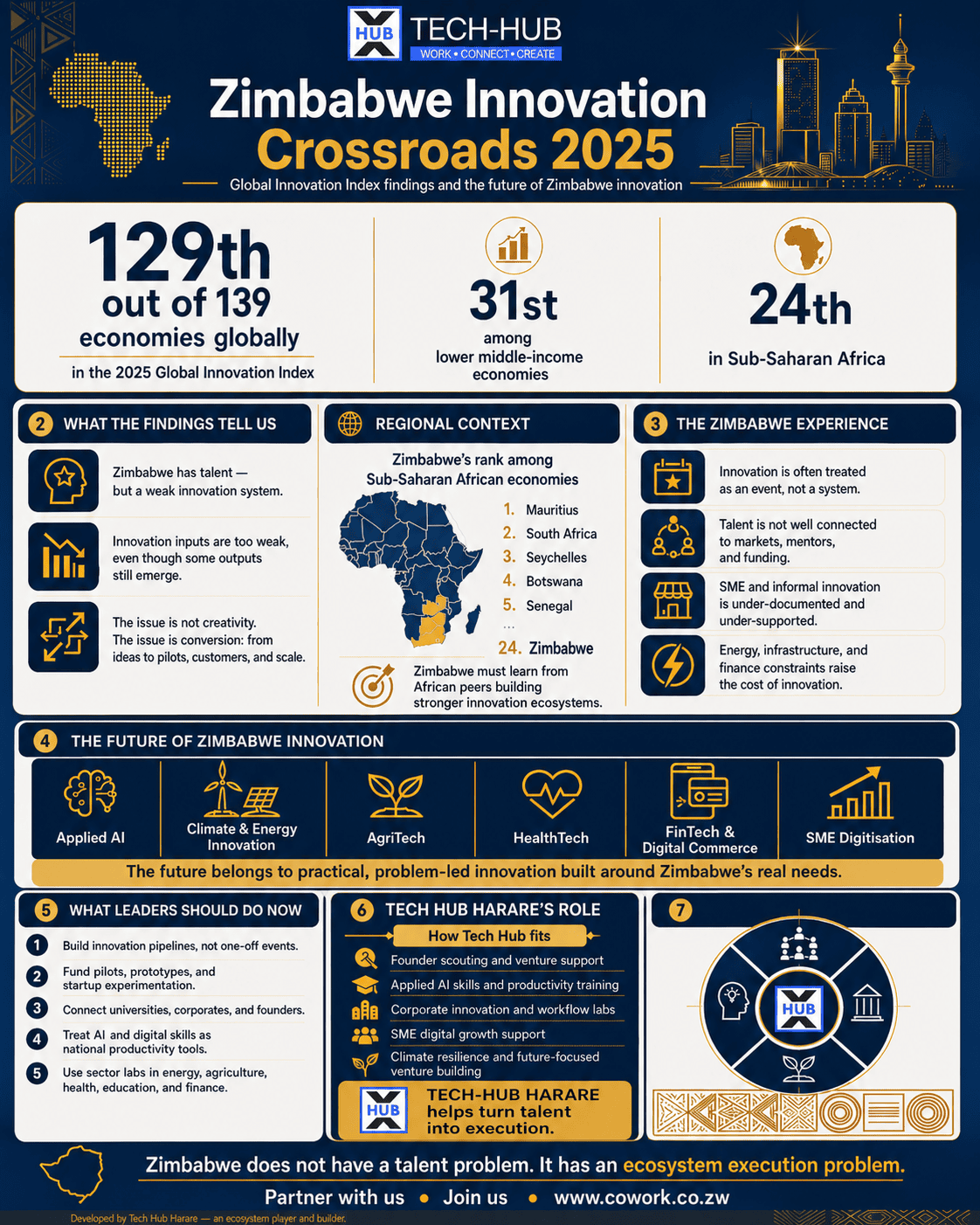
129th

out of 139 economies globally

Zimbabwe is ranked 129th globally, 31st among lower middle-income economies, and 24th in Sub-Saharan Africa.

15.4GII score
31stlower-middle income rank
24thSub-Saharan Africa rank

Zimbabwe's ranking of 129 out of 139 economies in the Global Innovation Index 2025 should be treated as a serious national signal. It is not merely a number on an international table. It reflects the state of our institutions, infrastructure, skills pipeline, business environment, innovation finance, research systems, technology adoption and ability to turn local creativity into scalable economic value.

The painful part is that the ranking feels familiar. Many Zimbabweans know that the country is full of talent, survival intelligence and entrepreneurial energy. Across the country, people solve problems every day under difficult conditions. Farmers adapt to climate pressure. SMEs use WhatsApp, mobile money, informal logistics and social networks to keep trading. Young people learn AI, coding, design and digital skills outside formal systems. Solar installers and technicians respond to energy insecurity in real time.

Yet the Global Innovation Index tells us that this energy is not being converted into a strong national innovation system. Zimbabwe is not failing because Zimbabweans are not creative. Zimbabwe is failing because our innovation ecosystem is weak, fragmented and under-supported.

The central message is simple: Zimbabwe does not have a talent problem. Zimbabwe has an ecosystem execution problem.

Tech Hub Harare exists to help close that gap.

What the findings show

Zimbabwe's innovation performance must be read as an ecosystem signal.

The GII uses innovation inputs and outputs to assess how economies create and convert ideas into social and economic value. For Zimbabwe, the issue is not only the final rank. The issue is the weakness of the system that should support innovators.

Global rank

129/139

Zimbabwe sits near the bottom of the global innovation table, showing the need for deliberate ecosystem rebuilding.

Income group

31st

Among lower-middle-income economies, Zimbabwe is still far from the leaders such as India, Viet Nam and the Philippines.

Region

24th

Within Sub-Saharan Africa, Zimbabwe trails regional innovators such as Mauritius, South Africa, Botswana and Senegal.

Core issue

System

The problem is not absence of talent. It is the weakness of the system that converts talent into innovation outputs.

Innovation inputs

Institutions, human capital, infrastructure, market sophistication and business sophistication. These are the conditions that allow innovation to happen repeatedly.

  • Policy stability and institutional support
  • Education, research and skills pipelines
  • Reliable energy, connectivity and infrastructure
  • Access to finance, markets and procurement
  • Business sophistication, technology adoption and data culture

Innovation outputs

Knowledge, technology and creative outputs. These are the visible results: platforms, companies, exports, patents, digital products, productivity and impact.

  • New products, services and platforms
  • Intellectual property, patents, trademarks and designs
  • Productivity gains in firms and public services
  • Creative outputs, digital content and software
  • Exportable ventures, jobs and measurable socioeconomic impact

The Zimbabwe experience

The ranking feels accurate because innovators operate inside difficult conditions.

Zimbabwe has practical innovation everywhere, but too much of it remains informal, underfunded, undocumented and disconnected from institutional support.

Tech Hub workspace, founder session, AI bootcamp, corporate workshop, or youth innovation event.
01

Innovation is treated as an event

Hackathons, conferences and expos create awareness, but they often lack structured pathways into pilots, customers, finance and scale.

02

Talent is not connected to opportunity

Young people and skilled professionals exist, but many are not connected to real problems, mentors, markets or institutions that can absorb their solutions.

03

Business innovation is under-documented

SMEs and companies adapt daily, but much of this activity is not captured as R&D, process innovation, intellectual property or investable case studies.

04

Energy and infrastructure raise the cost of survival

Unreliable power, expensive backup energy and weak infrastructure reduce the time and capital businesses can allocate to innovation.

05

Finance is not designed for innovation

Collateral-based lending does not fit early-stage innovation. Zimbabwe needs grants, pilot funding, revenue-based finance, challenge prizes and diaspora angel networks.

For corporates, universities and funders

Bring us a real problem. We will help build the innovation pathway around it.

Co-create a sector lab
AI

AI as productivity infrastructure

AI should be deployed as a practical tool for SMEs, schools, clinics, banks, insurers, public services and corporates — not only as a startup buzzword.

Energy as innovation infrastructure

Reliable productive power is foundational. Solar, storage and energy monitoring should be part of the national innovation competitiveness agenda.

📊

Data as ecosystem memory

Zimbabwe must document founder activity, SME digitisation, corporate pilots, university research, AI adoption and climate innovation to improve visibility and support.

Recommendations for leaders

Zimbabwe needs an innovation operating system, not another action document.

The way forward must be practical, measurable and connected to the real economy. The goal should be to move from scattered innovation activity to coordinated ecosystem execution.

This does not mean starting from zero. Important work is already being done by the Ministry of ICT, Postal and Courier Services, POTRAZ, Old Mutual, universities, development partners, private sector players, innovation hubs, incubators, accelerators and many ecosystem builders across Zimbabwe.

The opportunity now is to connect these efforts into a more visible, measurable and investable national innovation pipeline — one that links policy, infrastructure, skills, founders, corporates, finance, markets and community-level problem solving.

Tech Hub Harare’s role is not to replace what others are building, but to contribute to a stronger shared ecosystem by helping turn ideas, programmes, talent and partnerships into practical execution on the ground.

Partnership principle: Zimbabwe’s innovation recovery will not be built by one institution. It will be built by connecting the work already happening across government, regulators, corporates, universities, funders, hubs, founders and communities.

Recommendation 1

Create a Zimbabwe Innovation Recovery Plan

Use the GII pillars as a diagnostic tool. Identify the weakest indicators, assign responsible institutions, set annual targets and publish progress.

Recommendation 2

Move from events to pipelines

Every innovation event should lead into mentorship, prototyping, pilot customers, funding readiness, market access and measurable follow-up.

Recommendation 3

Put corporates at the centre

Corporates should publish real problem statements, fund pilots and use innovation to solve productivity, customer experience, energy and digital transformation challenges.

Recommendation 4

Build sector innovation labs

Focus on energy, agriculture, education, health, finance, informal commerce, public services, logistics and climate resilience.

Recommendation 5

Treat AI as a national productivity tool

Support practical AI adoption across SMEs, schools, clinics, councils, banks, insurers, law firms, accountants, manufacturers and call centres.

Recommendation 6

Create innovation finance mechanisms

Develop prototype funds, corporate challenge prizes, pilot budgets, diaspora angel networks, blended finance and revenue-based finance.

Recommendation 7

Build an innovation data culture

Track startups, patents, trademarks, software exports, AI adoption, SME digitisation, renewable energy systems and university commercialisation.

Recommendation 8

Use public procurement to open markets

Government and public institutions can create demand for local innovation by opening structured pilot and procurement pathways.

Shared responsibility

What each stakeholder should do now.

No single actor can rebuild an innovation ecosystem alone. The work requires government, corporates, universities, banks, investors, founders and ecosystem builders to play complementary roles.

Government

Use the GII ranking as a policy diagnostic, digitise public services, support regional hubs and open procurement pathways for local innovators.

Corporates

Fund pilots, publish problem statements, adopt AI, support sector labs and create supplier opportunities for local builders.

Universities

Link student projects and research to industry needs, commercialise knowledge and connect students to real customers and mentors.

Banks & Investors

Create small-ticket innovation finance, revenue-based finance, diaspora angel networks and climate innovation funds.

Founders

Build around real pain points, document traction, understand customers, learn AI and focus on execution beyond competitions.

Ecosystem Builders

Connect policy, talent, capital, corporates, universities and market access into a functioning innovation pipeline.

Where Tech Hub fits

Tech Hub Harare is already building the missing middle of Zimbabwe's innovation ecosystem.

The missing middle is the space between policy and execution, talent and opportunity, ideas and customers, research and commercialisation, corporates and founders, training and work, and technology hype and practical adoption.

Tech Hub Harare is not starting from theory. We have already been convening founders, hosting ecosystem events, running innovation programmes, supporting entrepreneurs, and creating a practical space where young people, SMEs, corporates, mentors and partners connect around real opportunities.

Through our work, including incubation support across seven cohorts, founder engagement, skills development, coworking, enterprise support and ecosystem convening, Tech Hub has already demonstrated what Zimbabwe needs more of: structured platforms that move people from ideas to execution.

The Global Innovation Index ranking does not create a new mission for Tech Hub Harare. It validates the mission we have already been pursuing: building the connective tissue that helps Zimbabwe turn talent, ideas and local problems into practical innovation, investable ventures and measurable impact.

7incubation cohorts supported
Eventshosted for founders, SMEs and partners
Programmesfocused on skills, entrepreneurship and innovation
Platformconnecting talent, mentors, corporates and opportunities
Tech Hub Harare innovation ecosystem infographic

Founder pipeline

Identify, support and showcase problem-led founders.

Corporate labs

Help companies turn pain points into pilotable innovation challenges.

AI adoption

Train SMEs and organisations to use AI for practical productivity gains.

Market access

Use the Digital Mall and partnerships to connect SMEs and builders to customers.

Our work so far

Since 2018, Tech Hub Harare has been building independently, consistently and visibly within Zimbabwe’s innovation ecosystem.

Since 2018, Tech Hub Harare has been part of Zimbabwe’s innovation landscape — supporting founders, hosting ecosystem activities, creating space for collaboration, and helping entrepreneurs, SMEs, young people and partners connect around practical opportunities.

Our work is not hidden. It is visible through the people we have engaged, the programmes we have supported, the events we have hosted, the cohorts we have worked with, and the digital footprint we continue to build across our website and social platforms.

This public record matters. It gives decision makers, founders, partners and funders a way to see the journey, verify the activity, follow the momentum and engage with Tech Hub Harare as a serious ecosystem builder.

Tech Hub Harare Hackathons
Tech Hub Harare Friday Networking
Tech Hub Harare collaboration

Independent visibility and recognition

Tech Hub Harare is visible across search, social platforms and ecosystem directories.

The Tech Hub story is not only told by us. It is also reflected through public search visibility, social media followership, ecosystem profiles and third-party directories that describe Tech Hub Harare as a platform, incubator and support network for founders, talent, entrepreneurs and ventures.

🌐Official website

Tech Hub Harare on cowork.co.zw

Our website positions Tech Hub Harare around founders, innovation, applied AI, digital skills, corporates, partners, talent and local businesses.

Visit cowork.co.zw →
fFacebook

1.8K+ Facebook followers

Our Facebook presence provides a public record of coworking, events, coaching, community activity and engagement with entrepreneurs and partners.

View photo archive →
𝕏X / Twitter

4.2K+ followers on X

Our X presence reflects Tech Hub Harare’s long-running innovation identity as a coworking and incubator platform helping innovative startups grow.

Follow @HarareHub →
inLinkedIn

990+ LinkedIn followers

Tech Hub Harare is visible on LinkedIn as a platform for founders, talent, corporates, institutions and partners building Zimbabwe’s next generation of ventures and skills.

View LinkedIn profile →
F6F6S

Startup support profile

F6S describes Tech Hub Harare as supporting young entrepreneurs with flexible working space, WiFi access and professional services.

View F6S profile →
AAfriLabs

Recognised as an incubator

AfriLabs lists Tech Hub Harare as an incubator helping entrepreneurs develop their ideas into scalable startup ventures.

View AfriLabs listing →

This visibility matters because innovation ecosystems are built on trust.

Followers, search results, ecosystem listings, event photos, founder memories and public-facing profiles all contribute to credibility. They show that Tech Hub Harare is not a paper concept. It has a footprint, a community, a history and a platform that can be scaled into Zimbabwe’s next innovation capability engine.

Public social footprint

1.8K+Facebook followers
4.2K+X followers
990+LinkedIn followers

Tech Hub action agenda

A practical response to the GII 2025 findings.

This document should lead to action. Tech Hub Harare can convene partners around a practical programme that turns the ranking from shock into strategy.

1

Response Roundtable

Convene leaders around the GII ranking and practical next steps.

2

Sector Sessions

Run focused sessions on energy, education, finance, health and agriculture.

3

Founder Scouting

Identify builders solving real Zimbabwean problems.

4

Applied AI Programme

Support AI adoption for SMEs, corporates and institutions.

5

Innovation Data Desk

Track ecosystem activity and document national progress.

6

Pilot Funding Pools

Mobilise small funding pools to test practical solutions.

7

Digital Mall Access

Help SMEs move from informal selling to structured digital commerce.

Partner with Tech Hub Harare

Let us build the ecosystem execution layer together.

We invite corporates, universities, funders, development partners, policymakers and industry associations to work with Tech Hub Harare on sector labs, AI adoption programmes, founder pipelines, SME digitisation and innovation data projects.

Partner options

  • Sponsor a sector innovation lab
  • Bring a corporate problem statement
  • Support a founder or youth skills cohort
  • Fund pilot projects and prototype grants
  • Host AI productivity workshops for your organisation
  • Partner on innovation data, research and ecosystem reports
Start partnership discussion

Join as a founder, builder or young innovator.

If you are building around energy, agriculture, education, health, finance, climate resilience, AI, digital commerce or public service improvement, Tech Hub Harare wants to hear from you.

Apply as a founder

Join as a mentor, sponsor or ecosystem partner.

Support founders with market access, pilot opportunities, technical mentorship, funding, training support, workspace sponsorship or sector expertise.

Support the ecosystem

Conclusion

From shock to strategy.

Zimbabwe can move up this ranking. But only if we stop treating innovation as an event and start building it as a system.

Tech Hub Harare is ready to play its part as an ecosystem player and builder.